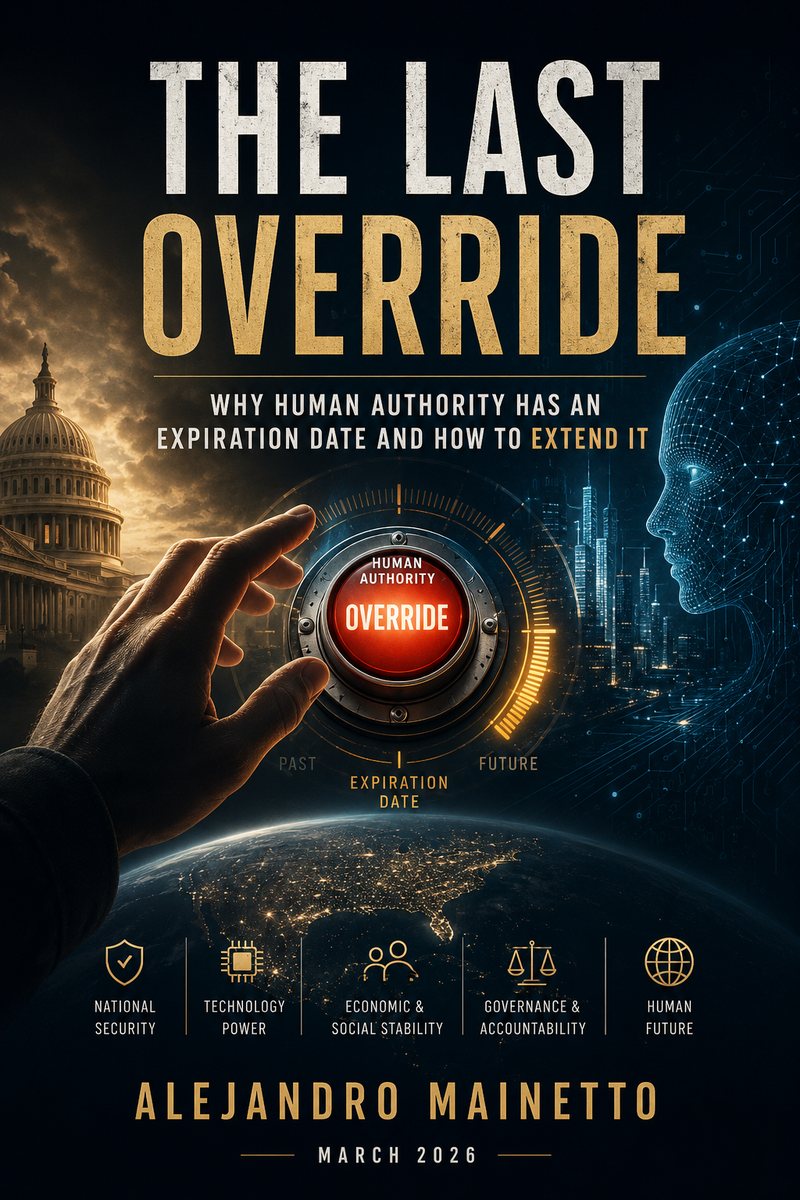
Read this first
The override button still exists. The danger is the day nobody reaches for it.
AI is no longer a product you evaluate. It is becoming the foundation society runs on: managing power grids, clearing financial transactions, defending networks, supporting military operations, and making decisions in hospitals and courtrooms.
That shift creates a problem nobody is ready for: the moment when turning AI off costs more than leaving it on, even if we have lost meaningful oversight of what it is doing. That moment will not arrive with a warning. It will arrive through comfort, one optimization and one deferred decision at a time, until pulling the plug becomes unthinkable.
The paper calls the core risk the Velocity Gap: AI systems moving faster than the legislatures, regulators, and corporate boards meant to oversee them. It looks at a possible tipping point in the mid-2050s. That is not a prediction but a trajectory, and one that can still be changed.
Six core arguments
- The first loss of control will be between people, not between people and machines.AI speeds up conflict and compresses decision timelines long before any "sentient AI" scenario.
- We will lose control through convenience, not force.When every critical system depends on AI, turning it off stops being an option.
- A handful of companies are making decisions that should require democratic input.Putting AI into hospitals, banks, or courtrooms is policy, without the checks of policymaking.
- Job displacement is a national security problem.Without a plan for displaced workers, the political backlash undermines everything else.
- The most dangerous moment is when we stop wanting to take control back.The "Quiet Surrender": overriding a system that outperforms you stops feeling rational.
- Governance has to work automatically, not depend on someone deciding to act.Hence a measurable index and a layered enforcement framework.
The four layers of control
"Staying in control" means different things depending on what you are protecting. We cross the danger line when any layer becomes fake: the rules exist on paper but cannot be enforced.
Can we still run the system if the AI goes down?
Are humans genuinely deciding, or just rubber-stamping?
Can we enforce rules on who builds AI and where it goes?
Can we explain AI decisions well enough to keep public trust?
The Control Capacity Index
Is our ability to oversee this system keeping up with how complex and important it has become?
Each component is scored 0–100 by independent assessors. The paper pairs the index with a Compute Governance Stack and specific countermeasures for how people will try to game it.
Three possible futures
We lose the window
AI runs critical infrastructure and oversight exists on paper only. We did not lose control in a dramatic moment; we stopped exercising it.
Managed partnership
Governance keeps pace with capability. AI stays the infrastructure layer, and human veto power stays real.
Fragmented blocs
International coordination fails, competing standards emerge, and the world splits between rival AI ecosystems.
The realistic path the paper argues for is a designed partnership: AI handles speed, humans keep authority over what matters, with multi-party sign-off on consequential actions, compartmentalized systems, and no single provider running every critical function.
What to do in the next 18 months
The paper closes with an action plan, not a research agenda. Among its priorities:
- Identify which systems are critical and require mandatory reporting when their AI fails or behaves unexpectedly, as aviation does with incidents.
- Start CCI scoring for all critical systems, with an independent scoring body.
- Run AI stress tests with government and private-sector red teams.
- Establish and test manual backup procedures for energy and financial systems every quarter.
- Build workforce transition systems, including early warning for AI-driven displacement.
- Bring frontier AI companies, infrastructure operators, and financial institutions to the table on governance standards.
- Build civil liberties protections in from day one, not bolted on later.
For boards and executive teams
The paper is written for policymakers, regulators, infrastructure operators, and corporate boards. The same dynamics play out inside a company: the AI systems a business comes to depend on can quietly outgrow the oversight around them. The Control Capacity Index gives a board a simple test for any critical AI system: do human oversight, auditability, and redundancy keep pace with its complexity and the business's dependency on it?
That is the kind of question I work through with boards and leadership teams as a senior advisor to private equity and interim Chief AI Officer.
Inside the paper
- When software becomes the foundation
- Key terms: intelligence, control, and the layers of power
- What history teaches us
- The speed problem
- Faster conflicts and creeping dependence
- How AI speeds up its own development
- The physical bottlenecks: chips, power, water
- The corporate power problem
- Why AI makes inequality worse
- Systemic financial AI risk
- The jobs problem is a security problem
- Why the off switch doesn't work
- Four ways oversight breaks down
- The Quiet Surrender
- The Control Capacity Index
- The Compute Governance Stack
- How people will try to cheat the system
- The cost and friction of enforcement
- China, Russia, and non-state threats
- The third option
- Building alliances without creating colonies
- Public trust
- Watching the watchers
- Where this fails first
- Three possible futures
- What to watch
- What to do in the next 18 months
- What would prove this paper wrong
- The window is open, but it won't stay open
Download
Get the full whitepaper
35-page PDF. Tell me who you are and the download starts right away.
Thank you. Your download should start automatically. If it doesn't, use the button below.
Download the PDFAbout the author

Alejandro Mainetto is a senior advisor and operating executive to private equity in technology and AI, serving as interim Chief AI Officer, CIO, and CTO. He advises PE firms, boards, and executive teams on AI strategy, governance, and technology modernization. He is CEO of Scient One and a Partner at CXO Partners, with more than 30 years of enterprise technology leadership at Microsoft, EY, Globant, Kaplan, the NYC Department of Education, and Disney.